
- ✓Hour-by-hour timing, see your best window tonight, not just the average
- ✓Moon phase & wash-out, know when moonlight will drown out faint aurora
- ✓Solar flare early-warning, get notified days before a flare-triggered storm
- ✓Push alerts, Kp threshold, Bz turns south, or your sky clears
Can you see the northern lights in Whitehorse?
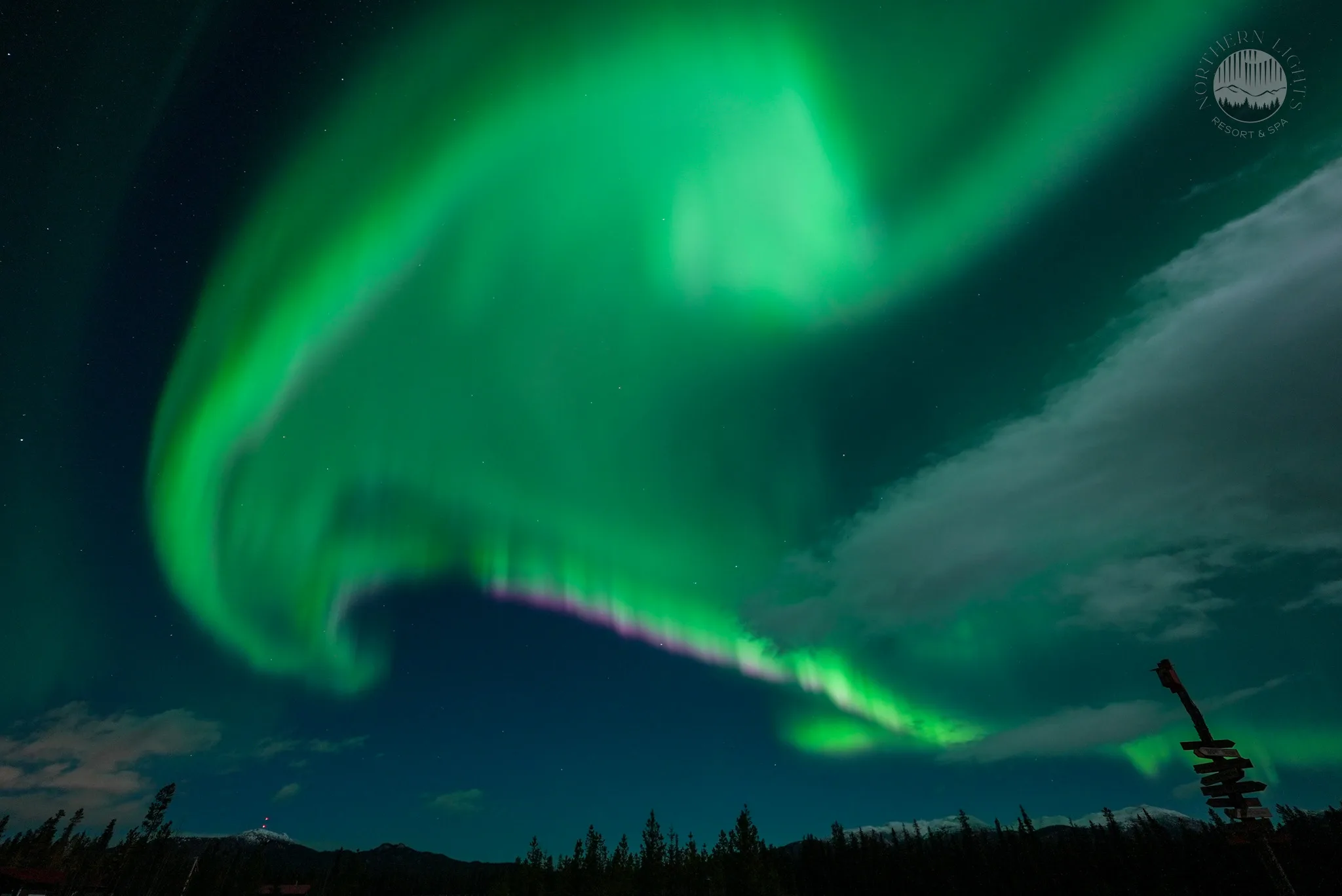
Yes. Whitehorse is a genuine Aurora destination on active nights. Whitehorse sits at a magnetic latitude of about 63°N, closer to the auroral oval than its map position of 60.7°N suggests, so the lights appear at a far lower Kp than most forecasts assume. On a clear night in season, the Aurora shows more often than not.
Aurora season in Whitehorse, month by month
Relative viewing probability, combining darkness hours, typical geomagnetic activity, and historical cloud cover for this location.
Best viewing spots around Whitehorse
Real locations we send guests to, scouted for dark skies, an open northern horizon, and safe winter access.


Why trust this forecast
This isn't a desk-built aggregator. Northern Lights Forecast is run by the team behind Northern Lights Resort & Spa, a TripAdvisor Best-of-the-Best property 25km south of Whitehorse. We've watched this exact sky across many seasons, and the calibration you see here comes from what actually shows up overhead, not just a textbook table.
Why Whitehorse needs the Kp it does
Magnetic latitude, not map latitude
Most forecasts rank a place by its geographic latitude. But the Aurora follows Earth's magnetic field, and the two don't line up. Whitehorse sits at 60.7°N on the map, yet its magnetic latitude is about 63°, which determines the real Kp threshold here.
That gap is exactly why generic tools mis-rate locations. We calibrate to magnetic latitude, which is why our minimum Kp here is 1.3.
| Kp 1 | Faint glow low on the horizon. You're here |
| Kp 3 | Bright arcs: movement, colour to the eye |
| Kp 5 | Storm: fills the sky, curtains overhead |
| Kp 7+ | Rare, dramatic; visible far to the south |
More destinations in Canada
Each is calibrated separately, so the Kp they need differs even within Canada.
Whitehorse Aurora FAQ
?What's the best month to see the Northern Lights in Whitehorse?
✓February and March are strongest, long dark nights, settled winter skies, and high geomagnetic activity. September and October are nearly as good with milder temperatures.
?What Kp do I need in Whitehorse?
✓Just 1.3. Whitehorse sits at about 63° magnetic latitude, well inside the auroral oval despite its lower map position, so it needs a much lower Kp than most forecasts assume. In our seasons operating here, that number has reliably brought the Aurora overhead.
?What time of night is best?
✓Roughly 00:00 to 04:00, with the strongest hour usually between 02:00 and 03:00. Magnetic midnight in Whitehorse falls at 03:06, and that is what matters rather than midnight on the clock: it is when the town passes closest to the midnight sector of the auroral oval. Displays commonly start with a false dawn in the late evening, go quiet, then build after midnight. Worth knowing if you remember the old advice of 11pm to 2am: that was right until Yukon stopped changing its clocks in 2020, and the same sky now happens an hour later on the clock.
?How many nights should I plan for?
✓At least three. Weather is the main variable, geomagnetic activity is reliable here, but you want several clear-sky chances. Multi-night stays dramatically raise your odds.